
There was a time when running Meta Ads felt like playing a strategy game you could actually win.
You picked your interests. You stacked your audiences. You excluded the people who didn’t fit. You tweaked a few settings, watched the data roll in, and adjusted from there.
If performance dropped, you changed your targeting. Simple.
That playbook is dead.
If you’ve been running Meta Ads for a while and things feel… off lately, you’re not imagining it. The rules changed. And the advertisers who haven’t caught on are spending more money for worse results while wondering what happened.
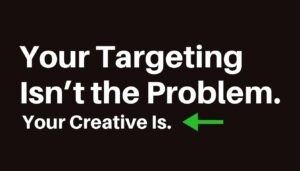
In fact, Meta rebuilt the entire engine that decides who sees your ads. And the single biggest shift? Your creative is now your targeting.
Let’s break down why, and what to do about it.
Meta Quietly Rebuilt Its Ad Delivery System
In late 2024, Meta started rolling out a new AI-powered ads retrieval system called Andromeda. By October 2025, it was fully deployed across every ad account on the platform.
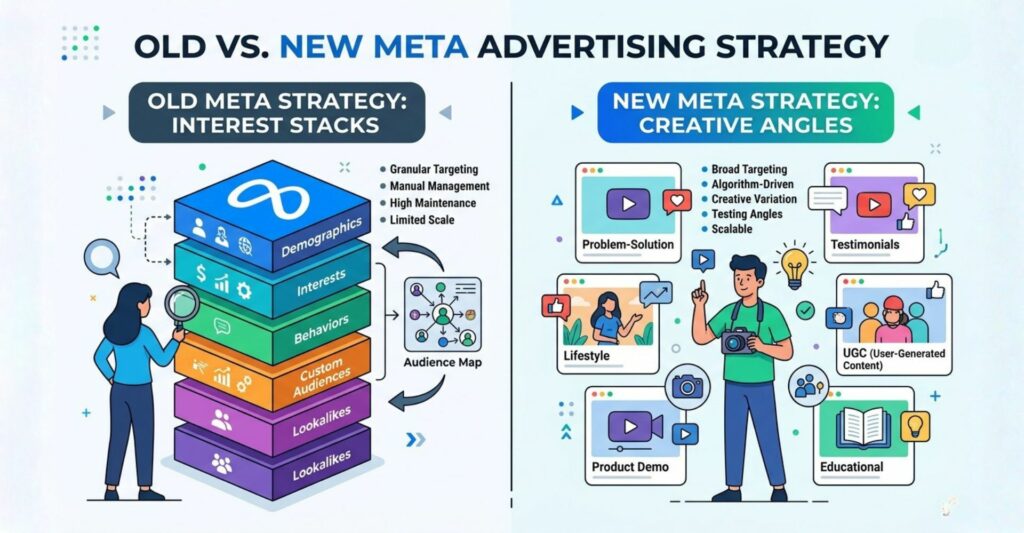
Andromeda completely changed how ads get delivered. The old system worked like this…you told Meta who to target, and the platform went and found those people. Simple enough.
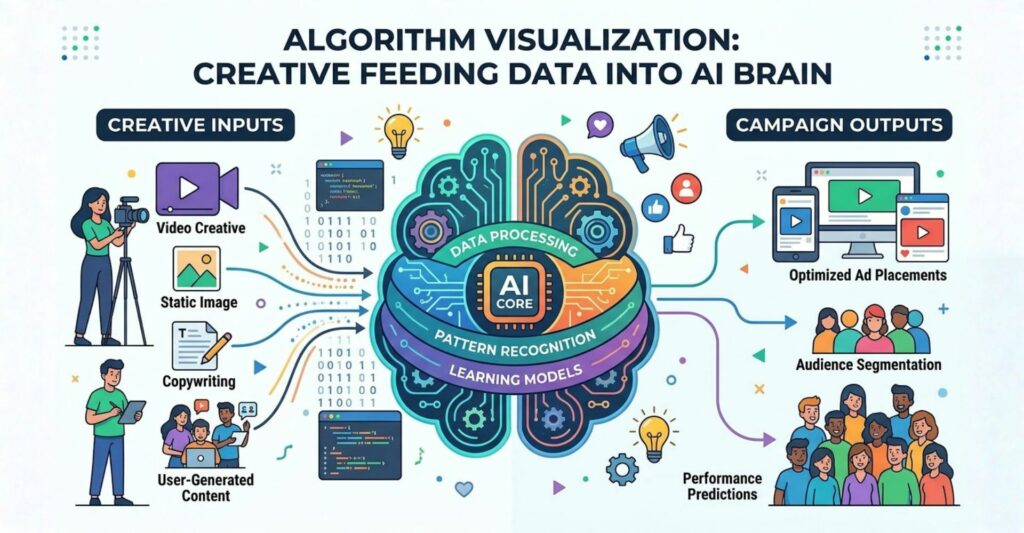
The new system works in reverse. Instead of starting with your audience settings, Andromeda first evaluates your ad creative, your copy, your format, and your historical engagement data. Then it predicts which users are most likely to respond. Your targeting inputs? They’re now treated more like soft suggestions than hard rules.
This is a fundamental shift. Meta went from an audience-first system to a creative-first system. And most advertisers haven’t adjusted.
Why Your Old Targeting Strategy Stopped Working
If you’ve noticed that your carefully built interest stacks aren’t performing like they used to, there’s a concrete reason for that.
In June 2025, Meta started consolidating detailed interest categories into broader groupings. Specific interests tied to sports, music genres, car models, food preferences, and more got merged together. That hyper-specific “Vegan Fitness” audience you used to target? Gone. Rolled into a broader bucket.
On top of that, Meta removed the ability to use detailed targeting exclusions entirely. You can no longer exclude users based on specific interests. Meta’s own testing showed a 22.6% lower median cost per conversion when advertisers didn’t use exclusions, so they took the option off the table.
What does all of this mean? The message from Meta is loud and clear…stop micromanaging your audiences. Let the AI do it.
And honestly? The AI is getting really good at it.
How Creative Became the Primary Targeting Lever
Meta’s algorithm analyzes how people respond to your ads. It tracks engagement, watch time, clicks, saves, shares, and conversions. It uses all of those signals to figure out who else should see your ad.
If your creative resonates strongly with a certain type of person, Meta finds more people like them. If your creative falls flat, the algorithm has nothing to work with, no matter how precise your audience settings are.
Think of your creative as a data engine. Every scroll-stop, every click, every 3-second video view tells Meta’s system something about who your ideal customer is. Strong creative generates clean signals. Weak creative generates noise.
This is why Advantage+ Shopping campaigns with broad targeting are now consistently outperforming manually targeted campaigns by 15-25% in ROAS, according to performance data Meta shared at their Q3 2025 Marketing Summit.
The old question was “Who should I target?”
The better question now is “What creative will attract the right people?”
Why Broad Targeting Feels Scary (But Works)
We get it. Running broad targeting feels like throwing money into the void. You’re used to controlling who sees your ads. Handing that over to an algorithm feels reckless.
But the data tells a different story.
Jon Loomer, one of the most respected voices in Meta advertising, now recommends prioritizing broader targeting with fewer restrictions as the default approach. His reasoning is straightforward: Meta’s algorithmic targeting already incorporates your pixel data, conversion history, and prior engagement. It already knows who your warm audiences are. You don’t need to tell it.
In fact, many advertisers find that 20-30% of a broad campaign’s budget naturally goes toward remarketing without any manual audience segmentation. Meta’s system prioritizes high-intent users first, then expands to find new prospects.
Broad targeting works because it gives the algorithm room to find patterns that humans can’t see. Detailed targeting narrows opportunity. Broad targeting with strong creative expands it.
The Three Types of Creative That Win Right Now
Not all creative is created equal. In 2026, the ads that consistently perform tend to fall into three categories:
Problem-Aware Creative: These stop the scroll by calling out a specific pain point. It works because it feels relevant. The viewer thinks “that’s me” before they even process that it’s an ad.
Outcome-Focused Creative: This type of ad highlights the transformation, not the features. Nobody cares about your product specs. They care about what life looks like after they buy.
Social Proof Creative: This is a biggie. Audiences are fatigued by overpromises. These ads leverage trust. Reviews, testimonials, UGC, real customers saying real things. In a world where everyone’s skeptical, proof is persuasion.
The brands that win aren’t relying on one “winning ad.” They’re rotating between these angles constantly and building a creative pipeline that feeds the algorithm fresh material.
Why Most Brands Are Testing Creative Wrong
Most advertisers think they’re testing creative. But what they’re actually doing is testing small variations of the same thing.
Changing a headline color, swapping a background image, or trimming two seconds off a video is not a real test. Under Andromeda, ads with a Creative Similarity Score above 60% get treated as redundant. The system groups similar ads together and suppresses delivery.
Real creative testing means testing fundamentally different things like different hooks, different emotional angles, different value propositions, different levels of audience awareness. It means giving Meta’s system genuinely distinct creative signals to work with.
The recommendation from industry experts right now is 10 to 15 conceptually distinct creative assets per campaign. That’s a big jump from the 3-5 ad sets most brands are running.
Creative Fatigue Is Faster Than Ever
Even your best-performing ad has a shelf life. And that shelf life is shrinking.
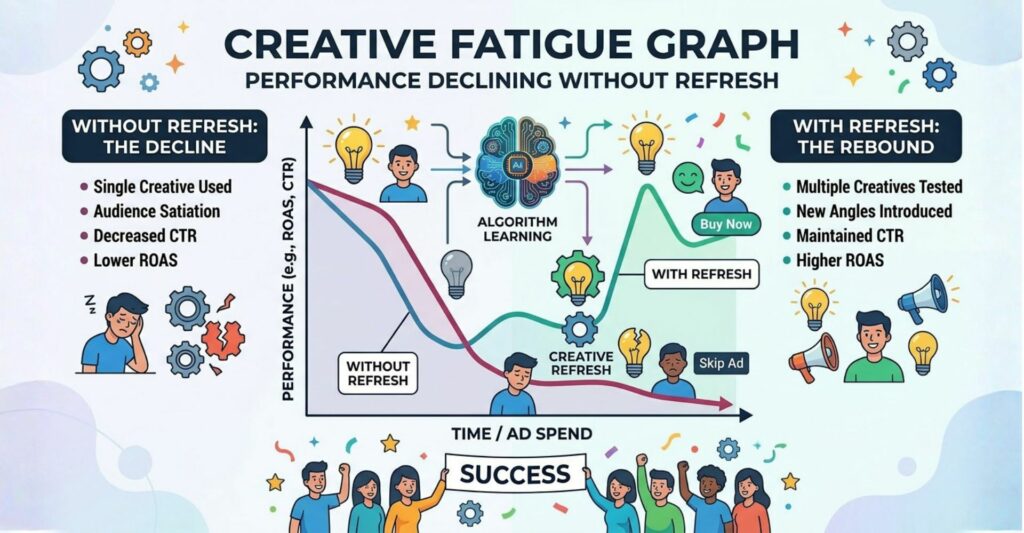
Because Andromeda is so efficient at matching ads to responsive audiences, top performers get served aggressively and burn out faster. Most brands now need creative refreshes every 1-3 weeks, not monthly.
This means scaling Meta Ads in 2026 is fundamentally a creative production problem. If your creative volume doesn’t increase with your budget, performance will decline. Period.
The brands that are scaling well have built systems for continuous creative production, not just occasional “let’s make some new ads” sprints.
Your Offer Still Has to Be Strong
Creative gets all the attention right now (and for good reason), but it doesn’t operate in a vacuum. Your offer still has to be clear and compelling.
In 2026, vague positioning gets buried. Your creative needs to answer three questions fast:
- Why this product? What makes it different or better than what’s already out there?
- Why now? What’s the urgency? Why should someone act today instead of scrolling past?
- Why trust you? What proof do you have that you deliver on your promises?
Without strong messaging behind it, even beautiful, well-produced creative falls flat. The algorithm can find the right people, but it can’t fix a weak offer.
How to Think About Meta Ads Going Forward
If you’re a business owner or marketing director still managing Meta Ads like it’s 2022, here’s the mindset shift…
Stop obsessing over audience settings. Meta’s own direction is clear, they’re moving toward full automation where you provide a URL and the AI handles everything else. That future is closer than you think.
Start obsessing over your creative. Your messaging. Your hooks. Your angles. Your production volume. Your testing framework.
The advertisers who are winning right now aren’t the ones with the cleverest targeting hacks. They’re the ones who treat creative like a system, not an afterthought.
Advertisers who have adapted to Andromeda’s creative-first approach are reporting 20-35% higher ROAS compared to those still running legacy campaign structures. That gap is only going to widen.
The Bottom Line
Meta Ads in 2026 run on creative signals, not demographic filters. Targeting has been automated. Optimization has become predictive. The control you used to have over who sees your ads has shifted upstream to what they see.
The brands that win from here aren’t the ones with the best targeting tricks. They’re the ones with the best creative systems, the clearest messaging, and the willingness to keep testing.
Creative used to be decoration. Now it’s strategy.
P.S. We help brands build creative-driven ad strategies that scale. If your Meta Ads performance has been inconsistent and you’re not sure why, let’s talk.