

Remember when SEO was all about stuffing keywords into your content and praying Google would notice? Those days are long gone. And if you thought the game changed when mobile-first indexing rolled out, buckle up, because AI is rewriting the entire playbook.
We’re not talking about minor tweaks to your keyword strategy here. ChatGPT, Google’s AI Overviews, Perplexity, and a dozen other AI tools are fundamentally changing how people find information online. And if you’re still optimizing content like it’s 2019, you’re already behind.
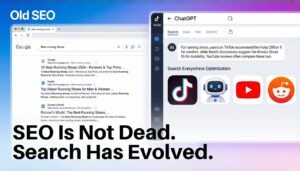
But there’s good news, SEO isn’t dead. It’s evolving. And if you understand what’s happening, and why, you can position your brand to thrive in this new landscape. Let’s break down what’s changing, what’s staying the same, and what you need to do about it.
The Rise of AI Search and Chatbots
From search engines to conversational interfaces
The shift is already underway. According to research firm Gartner, traditional search engine volume is projected to drop 25% by 2026 as AI chatbots and virtual agents handle more information queries. “Generative AI solutions are becoming substitute answer engines, replacing user queries that previously may have been executed in traditional search engines,” explains Alan Antin, Vice President Analyst at Gartner.
Think about it: instead of clicking through ten blue links, users are asking ChatGPT, “What running shoes should I buy if I have flat feet and run mostly on trails?” And they’re getting a synthesized answer pulled from multiple sources, formatted as a friendly conversation.
Google knows this. That’s why they’ve integrated AI Overviews into search results and the adoption has been explosive. As of November 2025, AI Overviews now appear in over 60% of U.S. Google searches, more than doubling their presence since August 2024. In just the first quarter of 2025, AI Overview triggers jumped from 6.49% of queries in January to 13.14% in March which is a 72% month-over-month increase.

How AI is reshaping user behavior
The behavior change is profound. Traditional search was transactional: query, click, scan, bounce, repeat. AI search is conversational: ask, refine, dig deeper, get nuanced answers.
Users expect:
- Immediate, synthesized answers instead of link collections
- Context-aware follow-ups that remember previous questions
- Personalized recommendations based on their specific situation
- Multi-source validation without the legwork
This isn’t just changing how people search—it’s changing what they expect from the content they consume. And it’s already having a measurable impact. According to SparkToro’s 2024 study, nearly 60% of Google searches now end without a click—users find their answer directly on the search results page and never visit a website at all.
Why SEO Still Matters in an AI-Driven World
AI needs trusted content sources
AI doesn’t create information out of thin air. ChatGPT, Claude, Perplexity, Google’s AI Overviews, they all need sources. They’re pulling from the web, synthesizing existing content, and citing (or at least training on) published material.
If your content isn’t discoverable, authoritative, and trustworthy, AI won’t use it. Simple as that.
Research from SE Ranking analyzing over 7,000 AI Overview instances found that 93.67% of AI-generated answers linked to at least one domain from the top 10 organic search results. The rich get richer, essentially. But that also means if you build genuine authority in your niche, you become a go-to source for AI answers.
The shift from rankings to credibility
Traditional SEO obsessed over ranking position: “Are we #1 for this keyword?” In the AI era, the question becomes: “Are we being cited as a credible source?”
Think about it differently. It’s more important to be the source AI trusts enough to reference when someone asks a question in your domain. That’s a fundamentally different optimization goal.
A study analyzing AI-generated responses found that AI search engines show “a definite preference for stronger domains,” with higher domain authority sites receiving disproportionate representation.
Looking at the most cited sources in AI Overviews reveals an interesting pattern: Reddit leads with 21% of citations, followed by Quora at 4%, NIH.gov at 1.8%, and WebMD at 1.5%. These are established, high-authority platforms that AI systems trust.
This means:
- E-E-A-T matters more than ever (Experience, Expertise, Authoritativeness, Trustworthiness)
- Brand recognition becomes an SEO factor (AI favors known entities)
- Content quality can’t be faked (AI is pretty good at detection)

Key Shifts in SEO for the AI Era
From keywords to conversations
Forget targeting “best CRM software.” You need to think about the conversations people are having: “What CRM works best for a 10-person sales team that’s remote-first and needs Slack integration?”
Research shows that queries triggering AI Overviews tend to be longer and more conversational. According to multiple studies, searches with eight words or more are 7x more likely to trigger an AI Overview than shorter queries. Long-tail keywords with four or more words resulted in AI Overviews 60.85% of the time in late 2024.
This means writing content that:
- Answers specific, nuanced questions
- Addresses follow-up concerns naturally
- Uses conversational language (because that’s how people talk to AI)
- Provides depth, not just surface-level keyword matching
Authority and trust as ranking essentials
Google’s been pushing E-E-A-T for years, but AI supercharges its importance. When an AI needs to cite a source about medical advice, legal guidance, or financial planning, it’s going to prioritize content from recognized experts and authoritative sites.
Google’s own Search Quality Rater Guidelines explicitly state that “Trust is the most important member of the E-E-A-T family because untrustworthy pages have low E-E-A-T no matter how Experienced, Expert, or Authoritative they may seem.”
Building authority means:
- Publishing consistently in your niche
- Getting cited by other authoritative sources
- Demonstrating real expertise (not just regurgitated Wikipedia content)
- Building author credibility with bylines and bios
Structured data and schema markup
If you’ve been sleeping on schema markup, wake up. AI systems love structured data because it makes content easier to parse, understand, and reference.
Implementing schema for:
- Articles (author, publish date, topic)
- FAQs (questions and answers)
- How-tos (step-by-step instructions)
- Reviews and ratings
- Events, products, recipes—whatever fits your content
This isn’t just about rich snippets anymore. It’s about making your content AI-readable.
Content depth and topical authority
Shallow content dies in the AI era. A 500-word blog post skimming the surface of “email marketing tips” won’t get cited when AI needs to answer detailed questions.
Instead, you need topical authority: comprehensive coverage of a subject area with interconnected, in-depth content. Think pillar pages, cluster content, and resources that actually serve as definitive guides.
From featured snippets to AI-generated answers
Featured snippets were the first taste of this shift with Google pulling a direct answer to display prominently. AI answers are that on steroids.
The difference is that featured snippets still send click-through traffic. AI-generated answers might not. Research from Seer Interactive analyzing over 3,000 queries found that organic click-through rates plummeted 61% (from 1.76% to 0.61%) for queries with AI Overviews, while paid CTR crashed 68%.
This means optimizing for citations and brand mentions within AI responses, not just traffic. You want AI to say, “According to Digital Time Savers…” even if the user never clicks through.
The New SEO Funnel in an AI World
The traditional SEO funnel still exists, but the dynamics have changed at every stage.
Discovery (Top of Funnel)
AI is now the discovery mechanism. People ask broad questions, get synthesized answers, and discover brands mentioned as sources.
Your goal: Be the authoritative source AI references when people ask top-funnel questions in your space.
Tactics:
- Create comprehensive guides on broad topics
- Answer common “what is” and “how to” questions thoroughly
- Build topical clusters that establish domain expertise
Consideration (Middle of Funnel)
Once someone knows about you (thanks to an AI mention or citation), they’ll dig deeper. This is where your content depth and brand credibility matter.
Tactics:
- Develop comparison content and in-depth reviews
- Showcase case studies and real results
- Publish thought leadership that demonstrates unique perspective
Conversion (Bottom of Funnel)
AI can drive discovery, but conversion still happens on your turf—your website, landing pages, and direct interactions.
Tactics:
- Optimize conversion paths for visitors coming from AI referrals
- Create product/service pages that align with how AI describes your offerings
- Use retargeting to re-engage people who discovered you via AI

Practical SEO Strategies for 2025
Creating conversational content
Write like humans talk. Use natural language, answer follow-up questions within your content, and structure articles as if you’re having a conversation with your reader.
The best way to do that is to anticipate the follow-up questions. When someone asks “What’s the best project management tool?” They’re going to follow up with. “How much does it cost?” and “Does it integrate with Slack?” Answer those questions in the same piece of content, the way you would if you were talking to someone face-to-face.
Use the language your audience uses. If your customers say “I need to track my macros,” don’t write about “monitoring macronutrient intake.” AI picks up on natural phrasing because that’s how people ask questions. And drop the corporate speak. AI is trained on billions of real conversations, and most of those don’t sound like a press release. If it sounds stiff when you read it out loud, rewrite it.
Building topical authority
Pick your lane and own it. Don’t spread yourself thin trying to rank for everything under the sun. Google and AI systems reward depth over breadth.
Go narrow, then go deep. If you’re a marketing agency, don’t try to cover all of digital marketing. Pick email marketing. Or better yet, pick email marketing for e-commerce brands. Then publish everything worth knowing about that specific slice. When AI needs to answer a question about abandoned cart email sequences, you want to be the source it can’t ignore.
You can also create content clusters, not random posts. Start with a comprehensive pillar page (think “The Complete Guide to Email Deliverability”) then build supporting content around it. Write about SPF records, DKIM authentication, sender reputation, IP warming and then link them all together. This shows search engines and AI that you’re not just scratching the surface.
And last, update your existing content religiously. Topical authority isn’t a one-and-done thing. If you published something in 2022, it’s probably outdated. Go back, refresh it with current information, and add new insights. Fresh, maintained content signals that you’re actively engaged in your topic area, not just churning out posts and abandoning them.
Optimizing for AI citations
Getting cited by AI means making your expertise easy to recognize and reference.
First, write in clear, quotable statements. AI systems pull specific claims and facts, not rambling paragraphs. Instead of burying insights in dense text, make them explicit. “Personalized subject lines increase open rates by 26%” is citable. A long paragraph discussing various factors that might influence open rates? Not so much.
Second, back everything up with data and always attribute it properly. Don’t just say “most marketers struggle with email deliverability.” Say “according to a 2024 Litmus study, 23% of marketing emails never reach the inbox.” Specific numbers with proper attribution make your content more credible to both humans and AI.
Third, use structure to your advantage. Clear headings and subheadings help AI quickly identify whether your content answers a specific query. “Why Your Email Deliverability Is Dropping” is way more useful than “The Problem.” And don’t skip the fundamentals—detailed author bios with real credentials and a solid “About” page that establishes your expertise aren’t just nice-to-haves. They’re signals that tell AI you’re a legitimate authority worth citing.
Doubling down on technical SEO
If AI can’t crawl your site, you’re invisible. Technical SEO fundamentals are non-negotiable.
Speed matters more than ever. A slow site frustrates users and makes crawling inefficient. If your pages take five seconds to load, you’re losing both human visitors and AI crawler attention. Compress images, minimize JavaScript, use a CDN. Make your site fast.
Mobile optimization is also necessary. More than 60% of searches happen on mobile devices. If your site looks broken on a phone or loads slowly on cellular connections, you’re done before you start.
Your site architecture needs to make sense. AI crawlers follow links to discover content. If your important pages are buried five clicks deep, they’re not getting found. Use logical internal linking, create clear navigation, build XML sitemaps. And fix crawl errors immediately. Broken links and redirect chains are signals that your site isn’t well-maintained.
Finally, HTTPS is mandatory, not suggested. If your site isn’t secure, it’s not getting indexed well. Security is a baseline trust signal that everything else builds on.
Prioritizing multimedia content
AI is getting better at understanding images, videos, and audio, which means your content strategy needs to expand beyond just text.
YouTube is still the second-largest search engine, and AI systems are increasingly pulling from video content to answer queries. If you can explain something on camera or in a screen recording, do it. You’re capturing both the YouTube audience and giving AI another format to reference.
Images matter too, but only if you do them right. Slapping a stock photo on your blog post doesn’t cut it. Use original screenshots, diagrams, and visuals that add value and always include descriptive alt text. AI uses that text to understand what’s in the image and when it’s relevant.
Long-form audio lets you go deep on topics in a way that feels natural and conversational. Plus, transcripts from podcast episodes become searchable, citable content that AI can pull from. And infographics are perfect for making complex data digestible and shareable, giving AI visual context for the information you’re presenting.
The more formats you use, the more entry points you create for both human discovery and AI citation.
Investing in brand signals
Brand mentions, even without links, matter in the AI era. Research analyzing AI citations across seven large language models found that brand authority and entity recognition play crucial roles in citation decisions.
This means your brand needs to exist beyond your own website. When AI systems are deciding which sources to trust and cite, they’re looking at your overall presence and reputation across the web.
PR and media coverage build credibility signals that AI picks up on. Getting mentioned in industry publications, news outlets, or authoritative blogs, even without a backlink, establishes that your brand is recognized and respected. The same goes for social media. An active, engaged presence shows you’re a real entity with an audience, not just a website churning out content.
Industry partnerships and collaborations reinforce your authority. Speaking at conferences, contributing to industry reports, co-authoring research, these activities get your name associated with other credible players in your space. And don’t underestimate reviews and testimonials! They’re social proof that real people have worked with you and found value, which matters to both potential customers and AI systems evaluating trustworthiness.
Case Study: A Travel Agency in the AI Era
Let’s look at a hypothetical example. A boutique travel agency specializing in sustainable tourism in Southeast Asia faces a challenge…how do they compete when people ask ChatGPT “plan me a sustainable trip to Thailand”?
Old SEO approach:
- Target keywords like “eco-friendly Thailand tours”
- Build backlinks from travel blogs
- Create basic destination pages
AI-era approach:
- Publish comprehensive guides on sustainable travel practices by region
- Create detailed itineraries with cultural context and environmental impact data
- Build topical authority around responsible tourism in Southeast Asia
- Include structured data for trips, reviews, and sustainability certifications
- Develop unique perspectives based on founder experience living in the region
- Get featured in sustainability and travel publications to build brand recognition
When AI needs to answer questions about sustainable Thailand travel, this agency becomes a cited source—not just another tour operator.
Challenges Ahead
Attribution problems
If AI answers questions without sending click-through traffic, how do content creators get credit or revenue? This is an unsolved problem that platforms, publishers, and regulators are still wrestling with.
The data is stark: analysis of over 300,000 keywords found that the presence of an AI Overview correlates with a 34.5% lower average click-through rate for the top-ranking page. Some publishers have seen traffic drops of 20-40% since AI Overviews rolled out.
But here’s the counterpoint: traffic from AI citations tends to be higher quality. Users who click through from an AI-generated answer already trust you as a source, you’ve been vetted by the AI. And brands that get cited in AI Overviews consistently see their brand recognition and authority increase, even when direct clicks decline. You’re playing a longer game now.
Content saturation
AI makes it easier to produce content at scale, which means more noise. Standing out requires genuine expertise and unique perspective, things AI can’t easily replicate.
According to a 2024 study, 42% of marketing leaders are already leveraging AI tools for content creation. But Google’s algorithms are evolving to detect and demote low-quality AI-generated content that lacks genuine expertise.
The good news? This levels the playing field for people with real expertise. Generic, AI-generated slop is easy to spot and getting easier to filter out. If you actually know your topic and bring original insights, you have a massive advantage. The content slop is noise, your expertise is signal.
Dependence on AI platforms
If Google, OpenAI, and other AI platforms control discovery, they also control access to audiences. Diversification with email lists, social media, direct traffic, becomes critical.
Google’s search volume actually grew by more than 21% in 2024 compared to 2023, but with AI Overviews appearing in 60% of searches as of late 2025, the nature of that traffic is fundamentally different.
Still, this isn’t the first time the rules changed. SEO has survived social media, mobile-first indexing, algorithm updates, and every “SEO is dead” prediction for the past two decades. The brands that adapt, that build genuine authority and diversify their channels, don’t just survive, they thrive. This is just the next evolution.
The Future of SEO in the AI Era
Towards Artificial Intelligence Optimization (AIO)
Some are calling it AIO instead of SEO, optimizing specifically for AI discovery and citation. Whether the acronym sticks or not, the concept is real: understanding how AI systems find, evaluate, and reference content.
A study on Generative Engine Optimization found that implementing GEO methods like including citations, quotations from relevant sources, and statistics notably boosted source visibility by over 40% across various queries.
Combining SEO with branding and storytelling
The brands that win in the AI era won’t just optimize for algorithms, they’ll build genuine authority through storytelling, unique perspectives, and real expertise that AI can’t replicate.
SEO becomes part of a broader content and brand strategy, not a standalone tactic.
Conclusion
Ready for some good news? SEO isn’t dead, it’s growing up. And the fundamentals still matter: create valuable content, build authority, maintain technical excellence, and serve your audience. But the execution is evolving.
In the AI era, success means thinking beyond rankings and traffic. It means building the kind of credibility and topical authority that makes AI systems trust and cite your content. It means writing for humans having conversations, not just algorithms parsing keywords.
The brands that invest in genuine expertise, comprehensive content, and strategic authority-building, will thrive. The ones clinging to outdated tactics will fade into irrelevance.
The question isn’t whether AI will change SEO. It already has. The question is: are you adapting fast enough?
Need Help Navigating SEO in the AI Era?
The shift to AI-powered search is happening fast, and staying ahead of it takes strategy, not guesswork. The Digital Time Savers team helps businesses (like yours!) adapt their content and SEO strategies for the AI-first world, building topical authority, optimizing for citations, and creating content that both humans and AI trust.
If you’re ready to future-proof your search strategy, let’s talk. Click here to reach out to us today!