

Performance Max is the most polarizing campaign type in Google Ads right now. Some advertisers swear by it. Others think it’s an expensive black box that takes credit for conversions it didn’t earn. Both sides have a point.
By early 2026, PMax accounts for roughly 45% of all Google Ads conversions and over 73% of advertisers are running at least one PMax campaign. It’s not going anywhere. The question isn’t whether to use it. The question is whether you’re using it in conditions where it performs, or conditions where it quietly burns through budget while the dashboard tells you everything is fine.
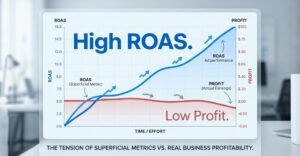
Because that’s the real issue with PMax. It doesn’t fail loudly. It fails in a way that looks like success.
This article breaks down what PMax does well, where it consistently wastes money, and how to tell the difference in your own account. If you’re spending on PMax and not sure whether those reported conversions are real growth or recycled demand, this is for you.

What PMax Actually Is (And What It Isn’t)
Performance Max is Google’s attempt to unify every ad placement it owns into a single automated campaign. One campaign, one budget, distributed across Search, Shopping, Display, YouTube, Discover, and Gmail. Google’s AI decides where your ads show, who sees them, and what combination of your assets gets served.
That’s a lot of power to hand over. And when conditions are right, it works. PMax can find conversion opportunities across channels that you’d never test manually. It can scale reach beyond what a Search-only strategy allows. For e-commerce brands with large product catalogs, strong feeds, and solid creative assets, it’s become a legitimate scaling layer.
But PMax is not a strategy. It’s a tool. And the confusion between those two things is where most of the problems start.
PMax needs strong inputs to deliver strong outputs. It needs clean conversion tracking, quality creative assets, a product feed that’s optimized (not just exported from Shopify and forgotten), and enough historical conversion data for the algorithm to learn from. When those things exist, PMax can compound results. When they don’t, it guesses. And Google’s guesses get expensive.
The Brand Cannibalization Problem
This is the elephant in the PMax room, and it’s backed by hard data.
An Optmyzr study of 503 accounts found that 91.45% had keyword overlap between Search and PMax campaigns. More than 56% of Search campaigns were affected. And here’s the kicker…when PMax and Search competed for the same search terms, Search outperformed PMax on conversion rate nearly twice as often.
What does that mean in practice? A chunk of the conversions PMax reports aren’t incremental. They’re conversions your Search campaigns would have captured anyway, often at a better rate.
This gets worse with branded traffic. PMax loves branded queries because they convert easily and cheaply. That makes the campaign’s numbers look great. But those are people who were already searching for your business by name. They were going to convert regardless. PMax is just intercepting them and taking credit.
A separate analysis by Adalysis across 3,300 PMax campaigns found a 45% overlap rate with Search, and Search had higher conversion values 84% of the time on overlapping terms. When nearly half your PMax conversions could have been captured by Search at a better rate, the “great ROAS” on your PMax dashboard starts to look very different.
This is why brand exclusions are essential. Google added campaign-level brand exclusions in 2024 and expanded negative keyword limits to 10,000 per PMax campaign in March 2025. If you’re running PMax without brand exclusions and a dedicated branded Search campaign running alongside it, you’re almost certainly overpaying for conversions you would have gotten anyway.

Where PMax Earns Its Keep
Strip away the inflated branded numbers and PMax still has legitimate value. But it earns it in specific conditions.
E-commerce with deep catalogs. If you have hundreds or thousands of SKUs and a well-optimized product feed, PMax can surface products across Shopping, Search, and Display in ways that would take dozens of manually built campaigns to replicate. The algorithm is genuinely good at matching products to purchase intent at scale. This is PMax’s strongest use case.
Accounts with mature conversion data. PMax learns from your conversion history. If your account has been running for a while with consistent, accurate conversion tracking (ideally with conversion values, not just counts), PMax has the signal quality it needs to make smart allocation decisions. New accounts or accounts with thin data give it almost nothing to work with.
Businesses with strong creative assets. PMax assembles ads dynamically from the headlines, descriptions, images, and videos you provide. If your assets are thoughtful, tested, and aligned with your offer, PMax can distribute them effectively across channels. If your assets are generic stock photos and placeholder headlines, the algorithm has nothing good to work with and your reach expands into low-quality placements.
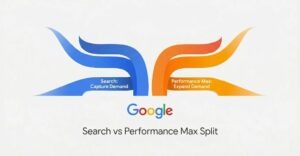
As a complement to Search, not a replacement. The advertisers getting the most from PMax are running it alongside well-structured Search campaigns that cover high-intent branded and non-branded keywords. Many advertisers see PMax driving 8-12% additional conversion volume beyond existing campaigns when both run simultaneously. The key word there is “additional.” PMax works best when it’s finding new demand, not cannibalizing demand you already captured.
Where PMax Burns Money
The conditions that make PMax powerful are the same conditions that, when absent, make it wasteful.
Weak or no conversion tracking. PMax optimizes toward the goal you define. If your tracking is incomplete, misconfigured, or counting the wrong actions, the algorithm optimizes for the wrong thing. This is especially brutal for lead generation, where PMax will happily fill your pipeline with junk leads if you’re optimizing for form fills instead of qualified leads. Without offline conversion data feeding back into Google, PMax has no way to distinguish a real prospect from a bot submission.
Low-quality assets. Headlines that say nothing specific. Descriptions full of corporate filler. Stock images that could belong to any business. If that’s what you’re feeding PMax, that’s what Google distributes across its entire network. The reach might expand, but the quality of that reach collapses. PMax is a creative and positioning challenge as much as it is a media buying one.
Vague or untested offers. PMax amplifies whatever you put in front of it. If your offer is unclear, your value proposition is weak, or your landing pages don’t convert well, PMax just sends more traffic to a broken experience faster. It doesn’t fix fundamentals. It scales them, for better or worse.
Not enough conversion volume. Google generally needs at least 30 conversions in a 30-day window for PMax to optimize effectively. Accounts with low volume or inconsistent conversion flow give the algorithm too little data to learn from. In those conditions, PMax tends to spend broadly across Display and YouTube placements (where impressions are cheap but intent is low) and the results feel scattered.
Blind trust. This one deserves its own line. Launching PMax “because Google recommends it” and then leaving it alone is probably the most common way budget gets wasted. Google’s incentive is for you to spend more. Your incentive is to spend profitably. Those aren’t always the same thing.

How to Use PMax Without Getting Burned
If you’re going to run PMax (and for most advertisers in 2026, you probably should), the key is treating it as one part of a larger system rather than handing it the keys.
Keep Search running. Your branded Search campaign should always be active and set at higher priority. Your non-branded Search campaigns should cover your core high-intent keywords. PMax should be finding incremental reach beyond what Search already captures. If your total conversions don’t grow meaningfully after adding PMax, you’re likely seeing cannibalization, not new demand.
Use brand exclusions from day one. There’s no good reason to let PMax bid on your brand terms. Exclude your brand name and variations inside PMax settings and let your dedicated branded Search campaign handle that traffic at a fraction of the cost.
Monitor the search terms report. PMax finally has more transparency than it used to. Check which queries are triggering your PMax ads. If you see your brand name showing up despite exclusions, or irrelevant queries eating budget, use the expanded negative keyword lists to clean it up.
Feed it good creative. Treat your PMax asset groups like real ad campaigns, not an afterthought. Strong headlines, specific descriptions, quality images, and ideally video. The better your inputs, the better the algorithm’s outputs across every channel.
Don’t evaluate PMax in isolation. The only way to know if PMax is actually helping is to look at total account performance: total conversions, total revenue, total profit. If PMax shows a great ROAS but your total numbers are flat, the campaign is reshuffling existing demand, not creating new demand.
For lead gen, feed back offline data. If you’re using PMax for leads, connect your CRM to Google Ads and import offline conversions. Tell the algorithm which leads actually turned into sales. Without that feedback loop, PMax will optimize for volume, and volume without quality is just an expensive way to fill a spreadsheet.
PMax isn’t inherently good or bad. It’s a powerful piece of automation that performs brilliantly in the right conditions and wastes money in the wrong ones. The businesses that get the most from it aren’t the ones who trust it blindly. They’re the ones who understand what it needs to work, what it can and can’t do, and where it fits within a broader strategy.
That’s the difference between letting Google run your ads and actually running a Google Ads strategy.
If you’re running PMax but aren’t sure what it’s actually doing for your business, we can help you find out. We build Google Ads strategies where PMax, Search, and Shopping work together instead of competing with each other. Book a discovery call and let’s look at what’s really happening inside your account.
See how we’ve helped other brands get more from Google Ads. Check out our case studies.