

Ask ten business owners how they handle paid marketing and you’ll hear a version of the same story. They run Google Ads because “people search there.” They run Meta Ads because “someone told them they had to.” Maybe they tested TikTok for a week because a competitor mentioned it at a conference.
Budgets get split. Campaigns get launched. Reports pile up. And despite being active on multiple platforms, most CEOs feel weirdly disconnected from their own marketing. They know money is being spent. They see clicks, impressions, maybe even a ROAS number that looks decent. But they don’t feel like they’re in control.
That disconnect is a strategy problem…
Global digital ad spend is projected to hit $910 billion by 2027, with businesses pouring money into an ever-growing number of channels. More money in the system doesn’t mean more results. It means more opportunities to waste budget if you don’t have a plan.
And that’s exactly what we’re going to give you here…a plan. By the end of this post, you’ll understand why platforms aren’t strategies, how to allocate budgets based on purpose instead of habit, the real difference between Google Ads and Meta Ads and when to use each, why full-funnel planning separates profitable brands from everyone else, and how to stop confusing testing with scaling before it eats your budget alive.
Media Buying Is Not About Platforms
There’s a common misconception that gets most businesses into trouble…they think media buying means “running ads on platforms.”
It doesn’t.
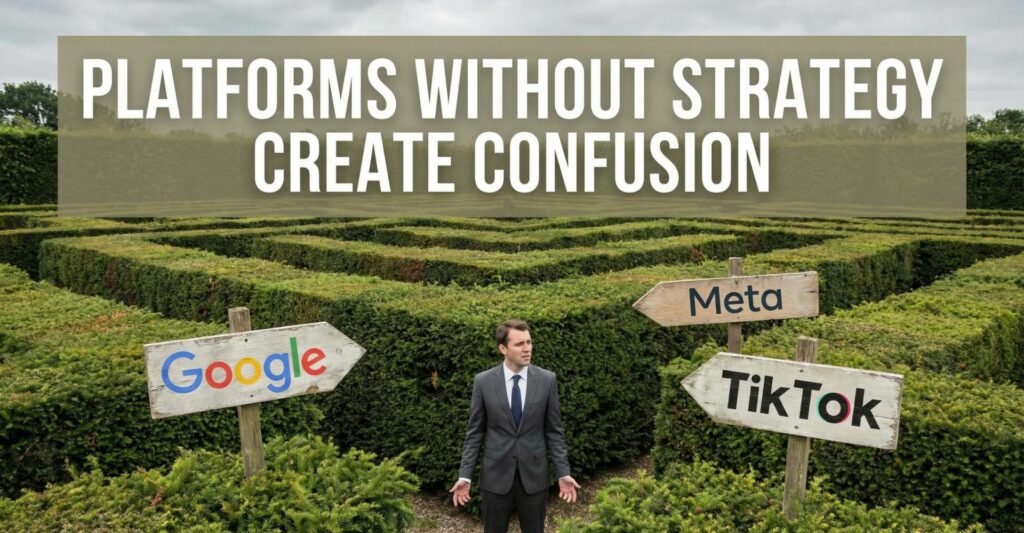
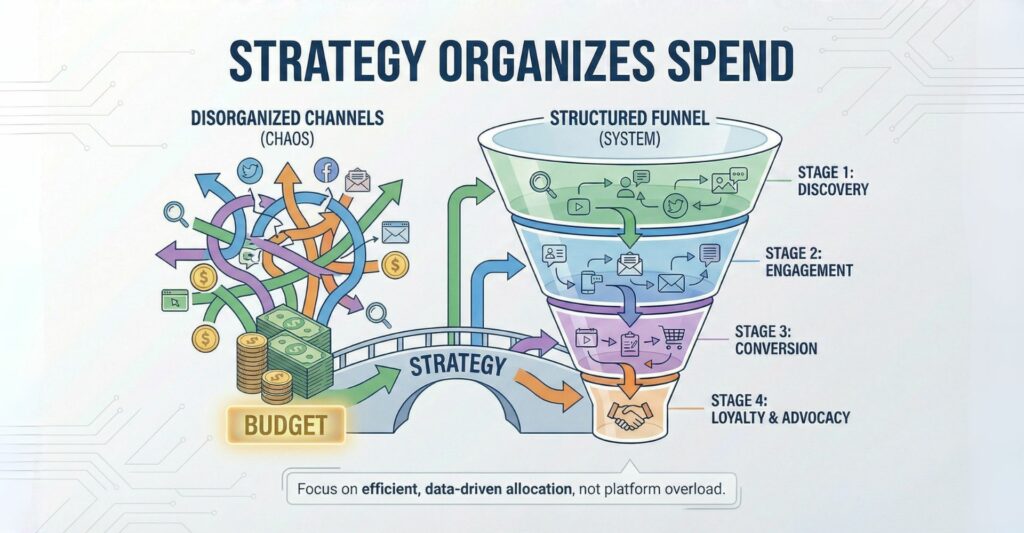
Media buying is a decision-making framework. Where to spend. How much to spend. Why you’re spending there. What role each channel plays in the bigger picture. Platforms are just distribution tools. Google, Meta, TikTok, YouTube, they’re pipes. Without a strategy behind them, adding more pipes doesn’t get you more water. It just makes a bigger mess.
This matters more now than it ever has. Both Google and Meta are aggressively pushing AI-driven automation into their ad platforms. Performance Max, Advantage+, AI-generated creative — the tools are doing more of the heavy lifting on the execution side. Which means the competitive edge is shifting fast. The brands that are the ones with the clearest strategy.
Why Most Businesses Feel Lost Across Channels
Most businesses don’t lack effort. They lack clarity.
They add channels without understanding their purpose. Google Ads, Meta Ads, remarketing, email, maybe a marketplace or two, all running simultaneously, often managed by different people or agencies.
Nobody’s asking the one question that actually matters: What job is each channel supposed to do?
When that question doesn’t get answered, everything breaks down. Performance becomes impossible to evaluate honestly. Channels overlap and cannibalize each other. Attribution turns into a guessing game. And decisions start getting made based on emotion instead of logic.
Research from Smartly’s 2026 Digital Advertising Trends Report found that marketers who diversify across platforms and embed strategy into their workflows are 27% more likely to waste less than 10% of their media budget. Meanwhile, the average marketer is still spending three to four weeks just getting a campaign from concept to launch.
Budget Allocation: The Decision Everyone Gets Wrong
If there’s one decision that separates good media buying from bad media buying, it’s budget allocation. And almost everyone handles it poorly.
Here’s how most budgets get set: past habits, gut feeling, platform recommendations, or whoever on the team argues the loudest. Sound familiar?
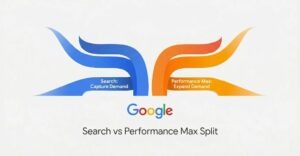
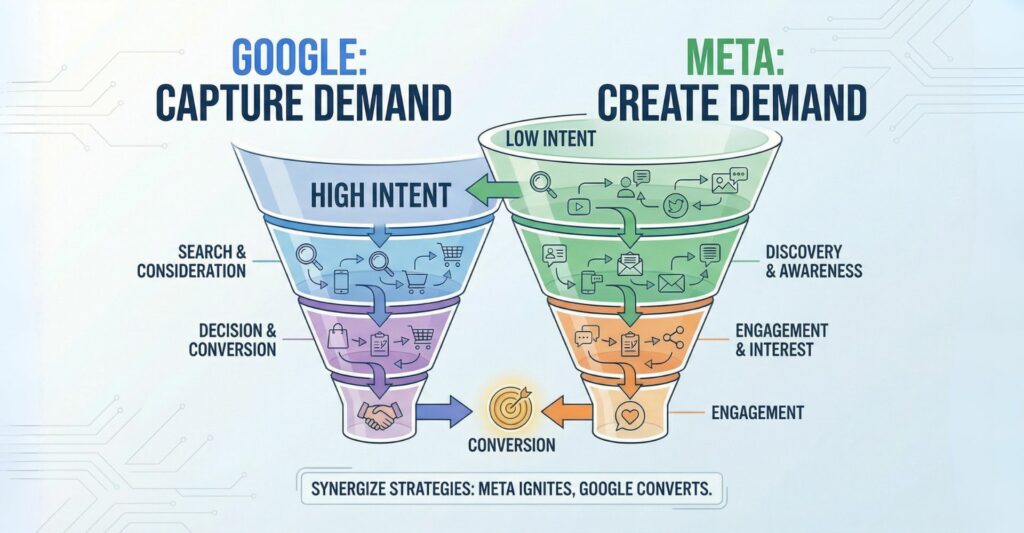
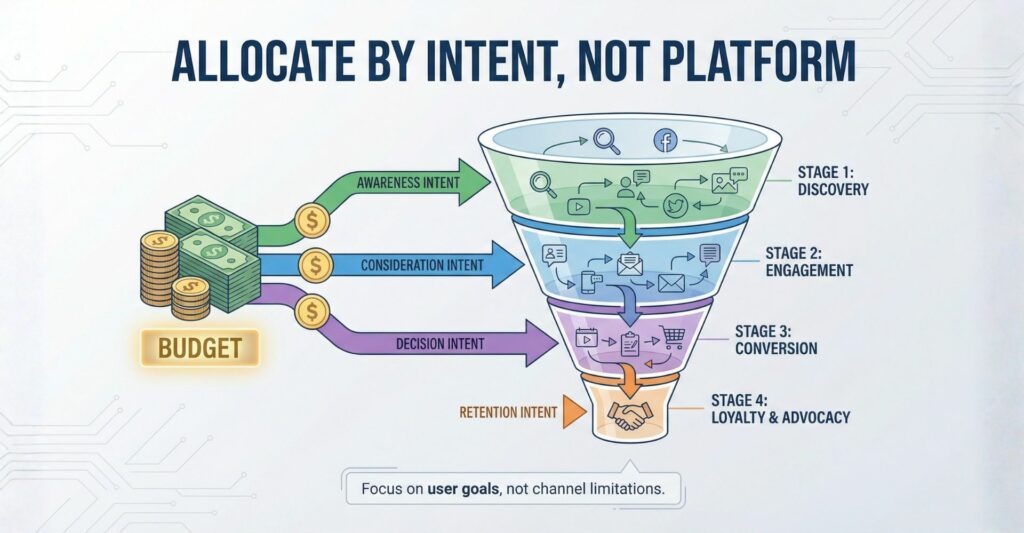
The smarter question isn’t “How much should I spend on Google Ads?” The smarter question is “How much should I invest in capturing existing demand versus creating new demand?” Those are two very different jobs, and they require different approaches, different creative, and different expectations.
When you allocate budget by channel name instead of channel purpose, you end up overspending where it’s comfortable and underspending where it actually matters. The broader advertising industry lost an estimated $26.8 billion in wasted programmatic spend in 2025 alone and a massive chunk of that waste came from budget flowing into channels without clear strategic purpose.
Google Ads vs Meta Ads: Two Very Different Jobs
Google and Meta get treated like competitors all the time. They’re not. They serve fundamentally different purposes, and understanding that difference is the first step toward sane media buying.
Google Ads capture existing demand and those with higher intent. Someone already wants something. They’re searching for it. Google’s job is to put you in front of that person at the exact moment they’re ready to act. It works best when intent is clear, urgency exists, and the solution is obvious.
Meta Ads create and shape new demand. Nobody on Instagram is searching for your product. They’re scrolling. Meta’s job is to introduce an idea, build interest, and influence decisions that happen later. It’s a discovery engine, not a search engine.
When businesses treat both platforms the same way, performance tanks. A search-heavy mindset applied to Meta means you’re expecting immediate conversions from people who don’t even know they have a problem yet. A discovery mindset applied to Google means you’re wasting money showing brand-awareness content to people who are actively ready to buy.
Plus, both platforms are also leaning harder into AI. Meta plans to offer fully automated ad creation by the end of 2026 – you’d provide a product URL and a budget, and Meta’s AI handles the rest. On the Google side, Performance Max now accounts for 45% of all Google Ads conversions, running campaigns across Search, YouTube, Display, Gmail, and Maps from a single interface. The automation is real. But automation without strategy just means you’re spending money faster and with less visibility into why.
Strategic media buying starts by assigning each channel a role. Not a budget.
Full-Funnel Planning: The Thing Most Businesses Skip
Most ad accounts are built bottom-up. All the focus goes to conversions first. Branding questions come later, if they come at all.
That approach works at small scale. But it breaks fast.
A full-funnel approach acknowledges a basic reality: not everyone is ready to buy right now. Different messages work at different stages. And demand has to be created before it can be captured.
Without top-of-funnel activity, your acquisition costs creep up over time because you’re fishing in the same shrinking pool of ready-to-buy customers. Without middle-of-funnel nurturing, your conversion rates suffer because people need more than one touchpoint before they commit. Without bottom-of-funnel efficiency, your profits disappear even when sales look healthy.
The numbers back this up. U.S. digital ad spend crossed $164 billion in 2025, with social and connected TV doing most of the heavy lifting. But the brands gaining ground aren’t the ones spending the most. They’re the ones connecting their top, middle, and bottom funnel into one coherent system.
Media buying strategy is the thing that connects those stages. Without it, you’re just running separate campaigns and hoping they somehow work together.
Testing vs Scaling: Know Which One You’re Doing
One of the most expensive mistakes in media buying is confusing testing with scaling. They’re two completely different phases, and they require different budgets, different expectations, and different success metrics.
Testing budgets exist to learn. You’re trying to figure out what works. What audiences respond. What creative resonates. What offer converts. The goal isn’t immediate ROAS, it’s insight.
Scaling budgets exist to exploit. You’ve already proven something works. Now you’re putting real money behind it to grow. The goal is predictable, profitable results.
Too many businesses skip testing entirely and jump straight to scale. They throw $10K at an unproven campaign and wonder why it didn’t work. Others test endlessly but never pull the trigger on scaling what’s actually performing. Both approaches burn money.
Smart media buying in 2026 separates these phases clearly. Testing budgets are protected, limited, and evaluated on learning — not revenue. Scaling budgets get deployed only when you’ve earned the right to spend more. That discipline prevents the emotional budget swings that sink most ad accounts.
Why Copying Someone Else’s Strategy Never Works
You’ve seen the case studies. “How We Scaled Brand X to $2M/Month With This Exact Funnel.” It’s tempting to think you can just copy the playbook and get similar results.
You can’t.
What worked for one brand almost never works the same way for another. Why? Because each business has different margins, different audiences, different products, and different buying cycles. A strategy built for a high-AOV luxury brand will fall flat for a $19 impulse buy. Context changes everything.
Timing matters too. A strategy that crushed it last year might already be outdated. Platforms evolve fast. Google launched over 60 AI-powered updates to Google Ads in 2025 alone. Meta is moving toward end-to-end automated ad creation. What the platforms can do changes quarter by quarter. Static playbooks can’t keep up.
This is also why cookie-cutter agencies struggle. If the agency’s approach is “here’s the template we use for everyone,” you’re not getting a strategy. You’re getting a service. There’s a big difference.
What Strategic Media Buying Actually Looks Like
Strategic media buying doesn’t chase platforms. It builds systems.
It starts with business goals, not campaign setups. It defines channel roles before anyone touches a budget. It treats data as guidance, not gospel. And most importantly, it evolves.
As performance changes, strategy adapts. Budgets shift based on what the data says, not what someone feels like spending. Decisions get made with context, understanding why something is or isn’t working, not panic.
This is the difference between managing ads and managing growth. One is reactive. The other is intentional.
The landscape in 2026 demands this kind of thinking. Ad Age predicts that media buying and strategy will become distinct responsibilities this year, which tells you something about where the industry is headed. Execution is getting automated. Strategy is what’s left. And it’s the part that actually moves the needle.
What This Means for Your Business
If your marketing feels complex but not effective, the problem probably isn’t execution. It’s strategy.
More platforms won’t fix confusion. More spend won’t fix inefficiency. Better dashboards won’t fix misalignment. What fixes it is clarity.
Clarity on channel roles. Clarity on budget purpose. Clarity on funnel stages. Clarity on what success actually means for your business, not what a platform report tells you success looks like.
Media buying in 2026 rewards businesses that think. Not just businesses that spend.
The Bottom Line
Media buying has grown up. Platforms have gotten more automated. Control has shifted from the advertiser to the algorithm. Costs have gone up. Complexity has exploded.
In that environment, the businesses that win aren’t the ones who master every button in Ads Manager. They’re the ones who master the decisions that happen before anyone logs in.
Businesses that treat media buying as a strategic discipline, not a platform checklist, will scale with confidence. The rest will keep feeling lost, no matter how many channels they’re on.
In 2026, strategy is the real advantage.
Need help building one? Digital Time Savers doesn’t just push buttons and send reports. We build media buying strategies that connect your channels, your budget, and your growth goals into one system that actually makes sense. If your paid media feels busy but not productive, let’s fix that. Get in touch and let’s talk about what strategic media buying looks like for your business.