

Last month, your ads generated $180,000 in revenue on $50,000 in spend. Clean 3.6x ROAS.
This month, you’re on track to do…$180,000 in revenue on $50,000 in spend. Same 3.6x ROAS.
The dashboard looks identical. Performance is “stable.” But you’re not growing.
You try doubling your budget to force growth. ROAS immediately drops to 2.1x. You pull back, and it recovers, right back to 3.6x at the same spend level you’ve been stuck at for months.
Nothing is broken. ROAS looks fine. Your campaigns are delivering. The platform says everything is optimized.
So why can’t you grow past this ceiling?
Because ROAS isn’t telling you the whole story. It’s a useful metric, one of the most important in e-commerce, but it’s incomplete. And when you’re trying to scale, that incompleteness becomes expensive.

ROAS Is Useful, But It’s Incomplete
ROAS is straightforward: Revenue divided by ad spend. Spend $1,000 on ads, make $3,500 in sales, you’ve got a 3.5x ROAS.
It tells you how efficient your spend is at a certain level. What it doesn’t tell you is how much volume is available at that efficiency, or how performance changes when you push beyond your core audience.
As spend increases, several things happen at once:
- Ads are shown to broader, colder audiences
- Competition in auctions increases
- Conversion rates naturally decline
- CPAs rise
None of this means ads are failing. It means you’re moving past the easiest wins.
The average e-commerce ROAS in 2025 is 2.87:1, with the median sitting at 2.04 according to Triple Whale’s data. But here’s what’s critical to understand: a “good” ROAS at $20K/month in spend doesn’t guarantee the same ROAS at $60K/month.
Businesses that rely only on ROAS to guide scaling decisions often feel stuck. They either stop scaling too early or push harder and sacrifice profitability.
Every Ad Account Has a Scaling Ceiling
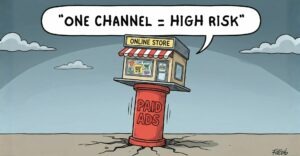
Every paid ad account has a natural efficiency ceiling. This ceiling is not fixed, but it always exists.
At lower spend, ads reach the most obvious buyers—people actively searching for your product, warm audiences who’ve visited your site, lookalikes of your best customers. These convert easily and efficiently.
As you scale, platforms are forced to expand delivery. That expansion reduces efficiency but increases reach. This is normal.
According to industry research, a skincare brand with 60% margins can operate profitably at a 2:1 ROAS, while a dropshipping business with 25% margins might need a 4:1 ROAS just to break even. The “right” ROAS depends entirely on your unit economics.
The mistake is assuming that good ROAS at one level guarantees the same performance at a higher level. Scaling is not linear. It’s a trade-off between efficiency and volume.
Understanding this early prevents unrealistic expectations and reactive decision-making.

Scaling Doesn’t Create Problems, It Reveals Them
One of the most important things to understand about scaling is this: scaling does not break systems, it exposes weak ones.
At low spend, small inefficiencies are easy to ignore. A mediocre product page might still convert at 2%. A slow checkout doesn’t hurt much when you’re only getting 500 visitors a day.
At higher spend, they become expensive very quickly.
Common weaknesses that surface during scaling include:
- Limited creative variety
- Unclear or inconsistent messaging
- Slow or confusing websites
- Weak trust signals
- Fragile funnels
When ads stop scaling, it’s rarely because of a single issue. It’s usually several small problems compounding at the same time.
Creative Fatigue Is Usually the First Thing to Break
When performance stalls, many businesses blame audiences or targeting. In reality, creative fatigue is almost always the first bottleneck.
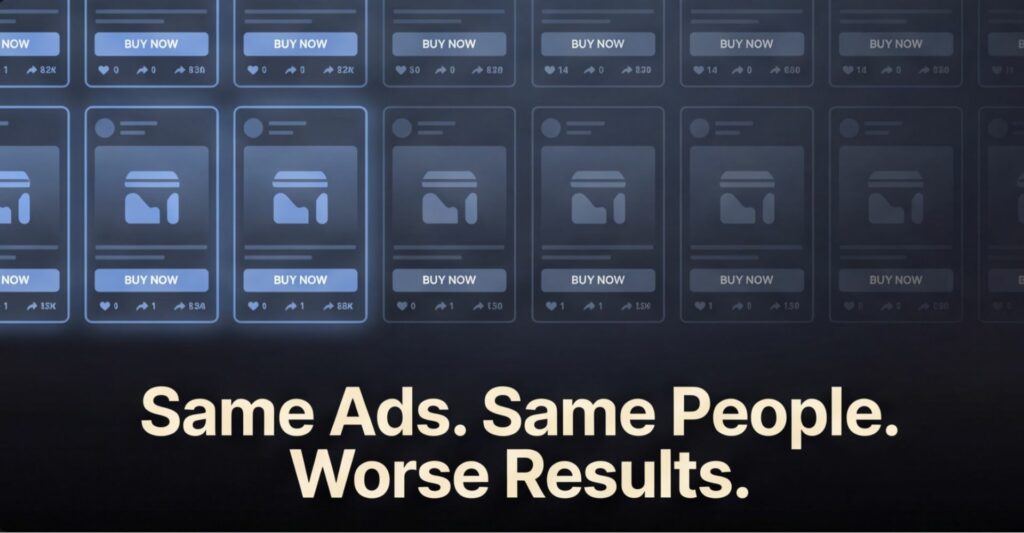
As spend increases, ad frequency rises. The same people see the same ads repeatedly. Engagement drops. CTR declines. CPMs increase.
Recent industry data shows that 69% of advertisers say creative fatigue happens faster than in previous years, and e-commerce brands are now hitting creative fatigue in just 7-14 days at higher spend levels, down from 4-6 weeks just two years ago.
At low spend, a handful of creatives might work for weeks. At scale, that same approach fails quickly.
Scaling requires:
- More creative angles
- Faster testing cycles
- Consistent refreshes
Creative quality matters, but creative volume matters even more once you start scaling. Industry experts recommend a minimum of 20 creatives for growth-stage brands, and 40+ creatives for scale-stage brands pushing $200K+ in monthly spend.
The formula: (Daily impressions ÷ 10,000) × 7 days = weekly creative requirement.
If you’re running 100,000 daily impressions, you need 7 new creatives weekly. That’s 28 per month minimum to maintain continuous freshness without gaps. At 250,000 daily impressions, you need 17+ new creatives weekly.
Audience Expansion Changes How People Respond
Warm audiences behave very differently from cold ones.
When ads are shown to users who already understand the problem, messaging can be direct and transactional. “Back in stock,” “Limited time offer,” “Free shipping today”—these work because the audience already gets it.
When platforms expand delivery to colder audiences, those users need more context, reassurance, and education. They don’t know your brand. They might not even know they have the problem you solve.
Many businesses try to scale by showing the same “buy now” ads to colder traffic. The result is predictable: lower conversion rates and higher CPAs.
Scaling requires adapting messaging to different awareness levels, not just increasing budget.
Platform Automation Reduces Control at Scale
Modern ad platforms are built around automation. As budgets grow, systems rely more on AI-driven delivery and less on manual control.
This means:
- Less granular targeting
- Broader audience expansion
- Fewer manual optimizations
Trying to fight this usually backfires. The platforms want you to feed them broad parameters and let the algorithm work.
The goal is not to control everything, but to feed the system the right signals through strong creatives, clean tracking, and clear conversion paths. Research shows that 74% of e-commerce advertisers believe AI-generated creatives will dominate by 2026, not because AI is smarter, but because it can produce volume at the speed platforms now demand.
Your Website Becomes the Bottleneck Faster Than You Think
Ads don’t convert customers. Websites do.
At low traffic volumes, a mediocre website can still perform “well enough.” At scale, every friction point becomes costly.
Small issues add up quickly:
- Slow mobile load times
- Unclear value propositions
- Weak product descriptions
- Missing social proof
According to Shopify’s research, making your website just one second faster can lead to a 7% rise in conversions. At scale, that difference compounds dramatically.
When conversion rates stop improving, scaling ads becomes inefficient. You can’t buy your way out of a weak website.
This is why CRO is a critical part of scaling, not an optional extra.
Scaling Ads Without Improving Conversion Rate Is Risky
Many businesses focus exclusively on ads and ignore conversion rate optimization. This creates a situation where more spend simply amplifies inefficiency.
Even a small improvement in conversion rate can unlock significant scaling potential. The same traffic generates more revenue, CPAs become more forgiving, and platforms receive stronger optimization signals.
CRO doesn’t just improve performance. It extends how far you can scale profitably.
The average e-commerce conversion rate in 2025 hovers between 2% and 4%. If your conversion rate is 2% and you improve it to 2.8%, you just increased revenue by 40% without spending an extra dollar on ads.
That same improvement also means your ads are now converting 40% better, which feeds better data back to the platform and improves future performance.
Brand Strength Quietly Affects Scaling
Brand is often overlooked in performance discussions because it’s harder to measure. But its impact becomes obvious at scale.
Recognizable brands:
- Convert better
- Experience lower CPAs
- Recover faster from performance dips
When people already trust you, ads don’t need to work as hard. This makes scaling smoother and more stable over time.
Branded search traffic converts at 5-10x the rate of cold traffic. If 30% of your paid ad clicks are from people who’ve heard of you before—through word of mouth, PR, influencers, organic social—you’re paying acquisition costs for warm traffic. That’s a better deal.

Retention Determines Whether Scaling Is Sustainable
Acquisition-focused businesses often underestimate retention. At scale, this becomes a major issue.
If every sale must come from paid ads, scaling becomes fragile. If customers return, subscribe, or repurchase, scaling becomes far more forgiving.
Industry data shows that acquiring new customers can be 5 to 25 times more expensive than keeping an existing one, yet most brands still allocate the majority of their budget to acquisition instead of retention.
Email, SMS, and post-purchase experience reduce pressure on acquisition channels and stabilize revenue during performance fluctuations.
A customer acquired at $40 who only buys once is a bad deal. That same customer who buys three more times over the next year? Now you’re profitable.
This is why customer lifetime value (LTV) matters more than ROAS when evaluating long-term scalability. Smart brands track Net Profit on Ad Spend (NPOAS), which factors in all costs beyond just ad spend and shows the net profit earned for every dollar spent on advertising.
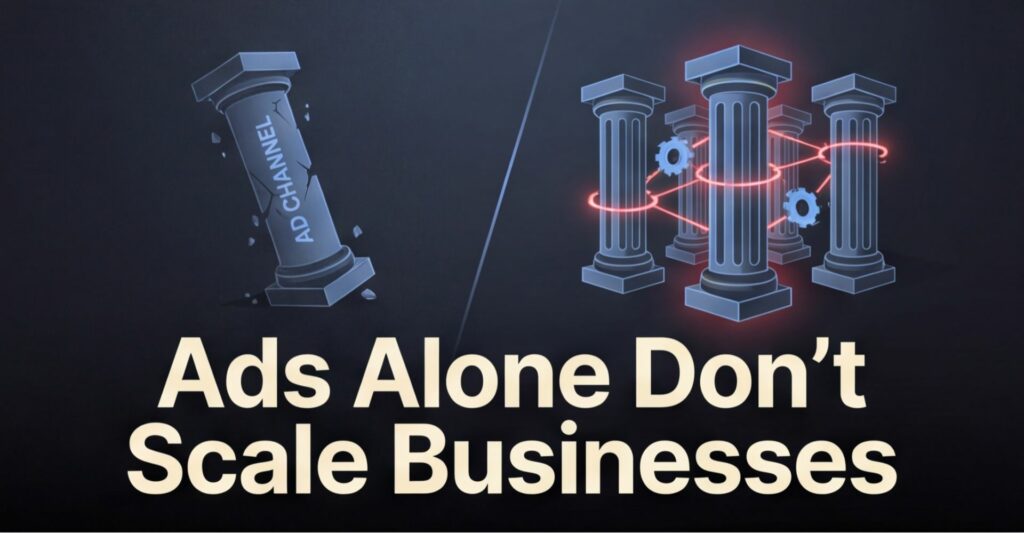
Scaling Is a Systems Problem, Not a Spend Problem
Scaling is often treated as a budgeting exercise. Spend more, expect more results.
In reality, scaling depends on alignment between:
- Ads
- Creatives
- Website
- Messaging
- Brand
- Retention
When one part lags behind, the entire system stalls.
This is why ads can look “fine” while growth stops. Your 3.6x ROAS might be perfectly healthy—but if your website converts at 1.6% instead of 2.4%, if your creative burns out every 10 days, if you have zero repeat purchase rate, you’ve hit your ceiling.
The ads aren’t the problem. The system behind them is.
Final Thoughts
Paid ads don’t stop scaling because platforms fail or algorithms change. They stop scaling because growth exposes limitations.
When ROAS looks good but revenue stalls, it’s not a signal to panic. It’s a signal to improve the system behind the ads.
Businesses that treat paid ads as part of a larger growth system—supported by strong creatives, CRO, brand, and retention—are the ones that scale profitably and sustainably.
Scaling isn’t about spending more. It’s about being ready for more.
If you’re stuck at a revenue plateau despite healthy ROAS, we can help. At Digital Time Savers, we don’t just manage ad campaigns—we build growth systems that scale. We look at the full picture: ads, creative velocity, site performance, retention, and brand.
Book a discovery call and let’s figure out what’s actually holding you back.
Want to see how we’ve helped other brands break through growth ceilings? Check out our case studies to see real results from stores that moved beyond ROAS obsession and built scalable systems.